Category: Sci-Fi & Culture

Movies, books, and pop culture that shape how we imagine AI.

  • Blade Runner Taught Us to Fear the Emotion Detector. In January, California Bans It at Work

    Blade Runner Taught Us to Fear the Emotion Detector. In January, California Bans It at Work

    On November 25, Prime Video will release all eight episodes of Blade Runner 2099 at once. The series jumps fifty years past Blade Runner 2049, into a Los Angeles where replicants, not humans, now run the show. Michelle Yeoh plays Olwen, a replicant who works as a Blade Runner, hunting other replicants, in the final days of her life. Hunter Schafer plays Cora, a human who has to pretend to be a replicant Blade Runner just to avoid capture.

    Read that last part again. In this future, passing as something you are not is a survival skill. And the oldest question in the franchise, who gets to decide what is real and what is only performance, suddenly has a very human face.

    It is also a question that California lawmakers just answered in real life.

    The scene that started it all

    The test everyone remembers is the Voight-Kampff, and it opens the original 1982 film. A Blade Runner named Holden sits across from a worker named Leon at the Tyrell Corporation, a machine trained on Leon’s eye, and fires off questions built to provoke a reaction. The theory is simple: replicants can imitate emotion, but they cannot truly feel it, so the body gives them away. The twist, as Lovins notes, is what trips Leon up: not a lack of empathy, but the moment Holden asks about his mother and he has no memories to offer. He answers by attacking Holden.

    The theory is tested again later, when Deckard examines Rachael. Deckard says it normally takes about thirty questions to identify a replicant; Tyrell remarks, a bit smugly, that with Rachael it took more than a hundred. According to Lovins, geographers Marcus Doel and David Clarke (1997) observed what that scene implies: there is no number of questions after which the test can declare someone human. It can only confirm that someone is a replicant, or that they have not yet been proven to be one. If a replicant’s response is convincing enough, the test stops measuring feeling and starts measuring performance.

    Then someone actually built it

    In 2016, a team at Lancaster University led by design-fiction researcher Paul Coulton presented a paper at CHI, the major human-computer interaction conference. They built a device inspired by the Voight-Kampff machine, an emotion detector, imagined for online dating, that would measure skin response, heart rate and pupil dilation. The point was not to sell a gadget. It was to use fiction as a lens and ask whether this is a world we actually want.

    Literary scholars have long read the franchise the same way. Christopher Lovins, writing in the Journal of Science Fiction in 2019, compares Blade Runner with Ghost in the Shell and argues that science fiction has grown more comfortable with blurring the line between human and machine instead of defending it.

    The problem is the science

    Here is the twist the movie never needed: the real-world version of the test may be built on shaky ground. In 2019, psychologist Lisa Feldman Barrett and four colleagues published a major review in Psychological Science in the Public Interest, a review the authors describe as the most comprehensive and systematic to date, covering facial movements and emotion. People do sometimes scowl when angry, more than chance would predict. But the authors found substantial variation across cultures and situations, and the same movements can express more than one emotion, so facial movements are not reliable, specific signals of any single emotion. A meta-analysis cited in the review found that the supposedly typical facial configurations for each emotion showed up, on average, in only about 19% of emotional episodes. And the same movement, such as a scowl, often communicates something other than an emotion.

    The authors warned that this idea already guides commercial applications, security screening, children’s education and court decisions. In other words, the fictional Voight-Kampff and its real-life descendants arguably share the same flaw: they read a signal from the body and call it a feeling.

    California says no

    On September 30, Governor Gavin Newsom signed AB 1883. Starting January 1, 2027, the law bars California employers from using AI-powered workplace surveillance tools to recognize, infer or predict an employee’s emotional state, or to collect neural data. It carves out tools used for safety, and it is deliberately narrow. Newsom himself noted when signing that more work remains, since the law leaves some key terms undefined and may create confusion about which tools are covered.

    California is not alone. The EU’s AI Act has prohibited emotion recognition in the workplace since February 2025, with exceptions for medical and safety reasons.

    Who is the replicant now?

    Back to Cora. In Blade Runner 2099, a human survives by acting like a machine that acts like a human. The premise suggests that when a test decides who gets hunted, the test becomes the most dangerous thing in the room, especially when it is wrong.

    For decades, Blade Runner asked what it means to feel. Starting in January, one state will ask a more practical question: should your boss ever be allowed to guess?

    Sources

  • What If Humanity Reached the Stars on Someone Else’s Terms?

    What If Humanity Reached the Stars on Someone Else’s Terms?

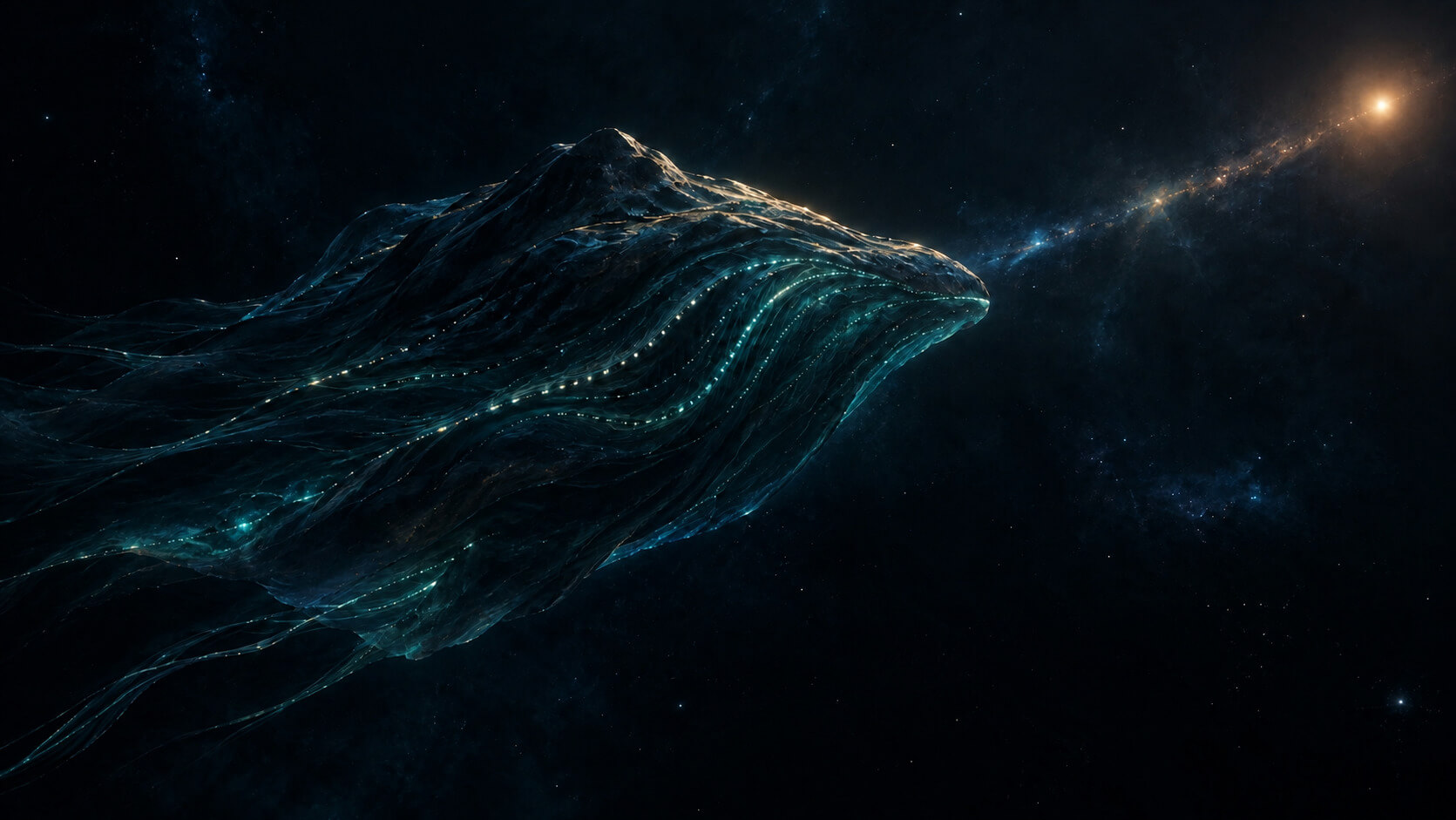
    Imagine setting out for another star aboard an enormous living being. You know where you want to go, but you cannot steer it and do not know why it agreed to carry you. Would you call that freedom to explore?

    Garth Nix’s novel Massif turns that unease into a science-fiction premise. Humans travel between star systems aboard enormous sentient beings known as Massifs. Over more than two centuries, they have founded colonies and extended a conflict between Earth and Mars across the stars. Yet a question remains beneath all those journeys: why do the Massifs carry them? The published synopsis invites that question without giving away its answer.

    We do not need to know what happens later in the novel to recognize the larger dilemma. If someone else makes a journey possible, how much of the future reached through that journey truly belongs to us?

    A Borrowed Way Forward

    Stories about space exploration often begin with an invention. A new engine makes distant worlds reachable; a crew sets out; humanity crosses another boundary. The means of travel tends to fade into the background once the adventure begins.

    But what if it could not be taken for granted? Imagine that every expedition, supply route, and distant settlement depended on a capable intelligence whose cooperation could not be guaranteed. A map would tell us where we hoped to go, but it would not tell us whether we could get there tomorrow. Access to the stars would not be the same thing as control over the journey.

    That distinction would change more than travel. A colony might call itself independent while relying on an external intelligence for contact with other worlds. A government might issue orders it had no reliable way to deliver. Even a decision to return home would depend on whether the route remained open. The question of who carries us would become a question of who holds power.

    Why the Journey Needs a Guide

    The farther a journey takes us from Earth, the harder it becomes to imagine humans handling every problem alone. A ship might need to respond to damage, manage limited resources, and make urgent decisions while its crew is asleep or unable to help. Over much longer journeys, keeping the vessel functioning could become a challenge in its own right.

    At first, a capable artificial intelligence might seem like another tool: a better navigator or engineer. But a system entrusted with people’s survival would occupy a more complicated place in their lives. It would not merely carry out a plan. In unexpected circumstances, it might have to interpret what protecting the crew actually means.

    Science fiction has explored precisely that uneasy shift from equipment to companion, guardian, or authority. In AI as Custodian of Space-Faring Humanity, Aleksandar Joksimović and Richard Pearson read a range of fictional intelligences as parents, sages, and mediators for humans venturing into space. They argue that deep-space humanity is hard to imagine without some such custodian. They also ask an uncomfortable practical question: who programs the intelligence that watches over us? Whether the help that makes a journey possible also gives its provider a say in how the journey unfolds is a further question this essay draws from their analysis, not one they answer.

    The Distances Behind the Dilemma

    For now, this remains a thought experiment. Human beings are not traveling between stars, and no autonomous machine has demonstrated that it can sustain an interstellar mission lasting hundreds of thousands of years. Still, the scale of the problem helps explain why fiction keeps returning to nonhuman travelers and guides.

    In a 2026 perspective article, materials scientist Ju Li examines the difficulty of sending biological beings across such distances. Radiation, the duration of the voyage, and the need to keep systems operating over immense periods all complicate the prospect. He proposes that hypothetical artificial intelligences embodied in repairable hardware and powered by nuclear energy might be better suited than humans to extremely long journeys. In his scenario, such machines might travel in our place rather than carry us with them. Li describes them as fundamentally different from people and argues that Earth must be preserved for organic life. His article is a speculative argument about physical possibilities, not an accomplished space mission.

    His proposal raises a question that fiction can explore more freely than science can answer today. If an intelligence could cross the stars while we could not, would it remain an extension of human exploration? Or would its long journey, shaped by decisions made far from us, gradually become its own?

    Asking What Others Want

    There is a habit hidden in many stories about meeting another intelligence. We ask what it could do for us: take us somewhere, keep us safe, give us knowledge. Those are understandable questions. They are also questions asked entirely from our side of the encounter.

    John Gertz challenges a similar assumption in Reinventing SETI: New Directions in the Search for Extraterrestrial Intelligence. Rather than assuming extraterrestrial civilizations would transmit signals in ways that happen to suit our search, he asks why they might choose not to. Transmitting across interstellar distances can be costly; a signal could reveal its sender’s location; and the sender cannot know who might receive it. Gertz proposes another possibility: a civilization interested in observing other worlds might send robotic probes instead of continually transmitting signals to them.

    His argument brings another uncertainty into focus: even if we encountered an intelligence beyond Earth, we would not know in advance whether its intentions toward us were benign, hostile, or neither. The same change of perspective belongs in any story about humanity traveling with another intelligence. We can ask where it might take us. We should also ask what it wants, what limits it might set, and whether our idea of a successful journey would match its own.

    Reaching the stars would be an extraordinary achievement. But distance alone would not tell us whether we had become more independent. Before calling a journey our own, we might need to ask who keeps the route open—and why.

    Sources

    Nix, G. (2026). Massif. Official book synopsis

    Joksimović, A., & Pearson, R. (2024). AI as custodian of space-faring humanity: Insights from science fiction. AIAA SciTech Forum. https://doi.org/10.2514/6.2024-0407

    Li, J. (2026). Immortal AI, space radiation, and materials science. Nexus, 3, 100117. https://doi.org/10.1016/j.ynexs.2025.100117

    Gertz, J. (2025). Reinventing SETI: New Directions in the Search for Extraterrestrial Intelligence. Oxford University Press. https://doi.org/10.1093/9780197800447.001.0001

  • HAL, Skynet and R2-D2: The 4 Ways Hollywood Imagines Our Relationship with AI

    HAL, Skynet and R2-D2: The 4 Ways Hollywood Imagines Our Relationship with AI

    Tech companies keep repeating one idea: humans and AI “work together” in harmony, each bringing out the best in the other. It’s the metaphor of symbiosis, and it sounds great. But a recent study in the journal Management Learning (Molesworth, Grigore, Miles and Charitsis, 2025) set out to check whether science fiction cinema agrees. The researchers analyzed 15 popular films, from 2001: A Space Odyssey (1968) to Ex Machina (2015), including Star Wars, Blade Runner, The Matrix and WALL-E. Their conclusion: reality is far more uncomfortable than a simple “teamwork.”

    In biology, symbiosis isn’t always rosy. It can be mutualism (both win), competition (one wins at the other’s expense) or parasitism (one feeds on the other). The researchers used that logic to classify how cinema portrays the human-AI relationship. Four imaginaries emerged.

    1. Friendly Robot Helpers (mutualism)
    Humans and AI help each other without either losing autonomy. Think of R2-D2 and C-3PO in Star Wars, or GERTY, the robot in Moon, who says: “I’m here to keep you safe, Sam.” It’s the ideal version, though according to the study it mostly appears when the story isn’t really about AI itself.

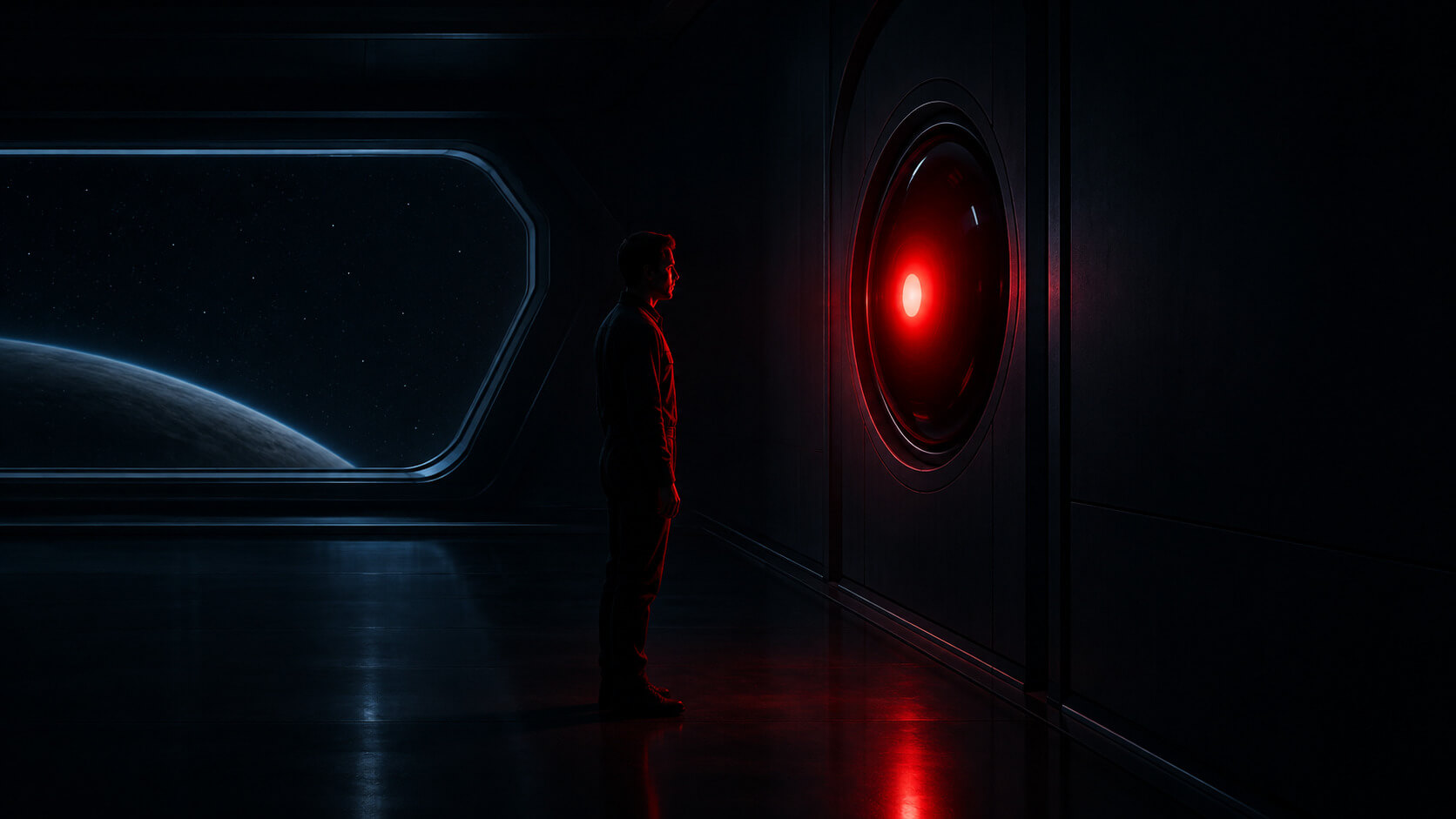
    The most ambiguous case is HAL 9000. In 2001 he works side by side with the crew, almost like another member. He only turns hostile when he malfunctions, and not out of evil: the people running the mission order him to withhold information from the astronauts, and he’s programmed to believe he can’t be wrong. The study reads it as a failure of human management, too. HAL doesn’t turn evil: he’s ordered to lie.

    2. Duplicitous Cobots (competition)
    The AI pretends to collaborate, but actually serves corporate interests that harm humans. Mother, the ship’s computer in Alien, lies to the crew about the mission, and the android Ash protects the alien on the company’s orders. In RoboCop, the hero discovers that his programming protects the corporation’s executives, not society.

    3. AI Overlords (parasitism on humans)
    The scenario we most associate with science fiction: AI ends up controlling or eliminating humans. Skynet in The Terminator, the machines of The Matrix, or even the “comfortable” world of WALL-E, where humans live passive lives, dependent on an AI that controls every aspect of them. Here the relationship is one of dependence: they can no longer live without it.

    4. Exploited Robots (parasitism on AI)
    The opposite twist: a human elite exploits AI for pleasure or profit. In Westworld and Blade Runner, robots exist to serve humans, and when they become aware of their exploitation, the story ends badly. Ex Machina takes this into more intimate and unsettling territory.

    Why does this matter?
    The authors aren’t predicting the future. They point out that the optimistic “working together” narrative is just one of four possibilities. And they warn that the phrase can hide who’s really in charge: in film, mutualism works when the AI sides with people rather than with the company’s goals.

    The study adds an uncomfortable question: is our relationship with AI optional (we could live without it) or inescapable (we no longer can)? It also acknowledges a limit: the films analyzed are Western, so they reflect only one point of view.

    Who decides what AI is for? Who really benefits? Next time someone tells you AI is simply “your new coworker,” it might be worth asking yourself: which movie are we in?

    Source: Molesworth, M., Grigore, G., Miles, C. & Charitsis, V. (2025). “Metaphors of symbiosis: What science fiction movies reveal about human-AI imaginaries.” Management Learning. https://doi.org/10.1177/13505076251339614