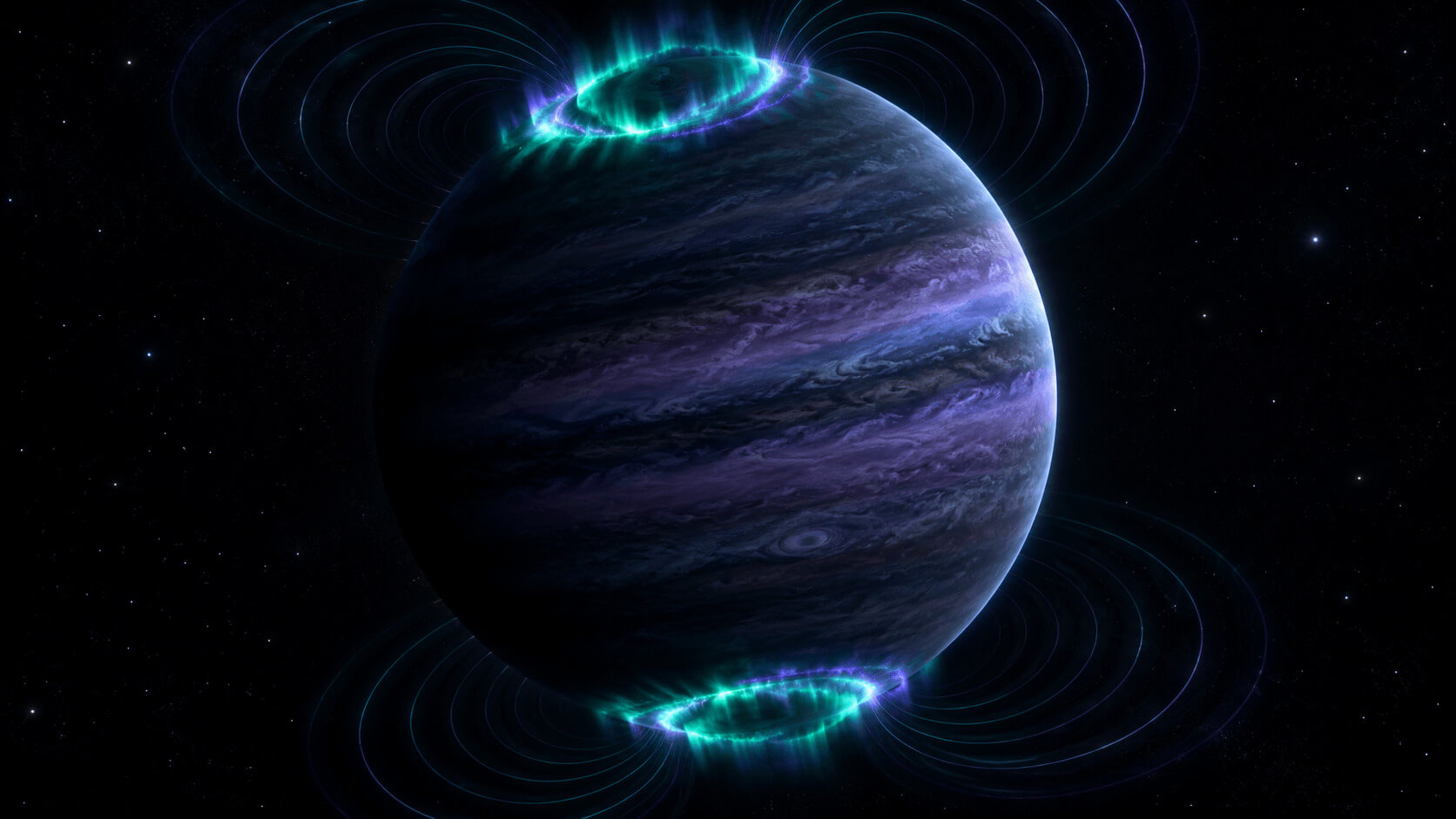
A research team from the Center for Astrophysics at Harvard & Smithsonian, working with the University of Oregon, has just pulled off something that had never been done before: they detected radio emission and, for the first time, definitively traced it to a specific exoplanet rather than its star. It’s not a message. It’s not contact. But it may be the most concrete step taken in decades toward answering one of astronomy’s most uncomfortable questions: why, if the universe is so vast, have we not found intelligent life?
The question is said to have been asked over lunch. In 1950, at Los Alamos, physicist Enrico Fermi was chatting with colleagues about UFO reports when he interrupted with a remark that has outlasted the conversation itself: where is everybody? It sounds casual. It isn’t. The Milky Way holds somewhere between two and four hundred billion stars, many of them billions of years older than the Sun. Thousands of exoplanets have been confirmed since the mid-1990s, and the data suggests planets are the rule, not the exception. By the numbers, the galaxy should be loud. Instead, it’s silent.
The math that makes it worse
Here’s the part most explanations skip: the paradox isn’t really about distance. It’s about time. A civilization that never travels faster than one percent of light speed, well within known physics, could cross to a neighboring star in a few centuries. Settle there, wait a thousand years, send out two more expeditions, repeat. That pattern spreads exponentially. Run the numbers, and a single civilization could occupy the entire galaxy in five to fifty million years. Against a galactic history of thirteen billion years, that’s roughly one part in three hundred; practically no time at all. If even one civilization had arisen a hundred million years ago and expanded this way, its traces should be everywhere. Including here.
The Great Filter
In 1996, economist Robin Hanson proposed a resolution now widely discussed among researchers studying this problem: somewhere between lifeless chemistry and a durable, galaxy-spanning civilization, there must be at least one step so improbable that almost nothing gets past it. He called it the Great Filter. It could be the origin of life itself, the jump from simple to complex cells (which took life on Earth roughly two billion years to manage, and appears to have happened only once), the emergence of general intelligence, or something none of us have hit yet. That last possibility is the uncomfortable one: if the filter is still ahead of us, it means civilizations reliably arise and reliably fail, and there’s no particular reason to assume we’re the exception.
Sixty years of listening
The search for extraterrestrial intelligence has been running since 1960, through modern efforts like Breakthrough Listen, which scans huge numbers of nearby stars across wide frequency ranges. No confirmed detection has ever been made. The famous “Wow!” signal from 1977 was never repeated or verified. But the silence comes with an asterisk: researchers reviewing the field describe the total volume of sky searched so far as comparable to sampling an entire swimming pool with a single drinking glass. The effort is real. The coverage is still thin.
How they pulled it off this time
The planet is Beta Pictoris b, a gas giant roughly ten times the mass of Jupiter, discovered back in 2008. Using South Africa’s MeerKAT radio array across four observing sessions in 2025 and 2026, the team picked up rapid, recurring bursts of radio emission, strongly circularly polarized, in the same frequency range that produces auroras on Earth and Jupiter. The hard part wasn’t detecting a signal. It was proving where it came from. Earlier attempts to catch radio emission from planetary systems always ran into the same wall: no reliable way to tell whether the signal was coming from the planet or from its much brighter host star sitting almost on top of it in the sky.
To solve that, the researchers anchored their measurements to nine distant quasars and one VLBI calibrator, essentially using the most stable reference points in the observable universe to correct for tiny distortions in their instrument. Once corrected, the radio source lined up with Beta Pictoris b’s position with high statistical confidence, while the host star was ruled out at a significance so strong it’s effectively certain they’re looking at the planet.
What the signal actually is
Here’s the part worth sitting with: this is not a message. The emission matches a well-understood natural process called electron cyclotron maser instability, the same mechanism behind auroras on Earth and Jupiter. What it reveals is something arguably more useful than a message would be: a direct measurement of the planet’s magnetic field, calculated at over 1,000 times stronger than Earth’s. It’s the first time anyone has directly measured a magnetic field on a world outside our solar system, and the number matches theoretical predictions for how young gas giants generate their magnetism almost exactly.
Why this matters for the paradox
At first glance, a magnetic field measurement seems to have nothing to do with the search for alien civilizations. But it matters for a specific reason: it demonstrates, in practice, the exact kind of rigor that a genuine technosignature detection would require, and that most past candidate signals never had.
For decades, one of the more mundane explanations for the Fermi Paradox has simply been that our searches haven’t been good enough yet, not that no one is out there. The Beta Pictoris b result is a working demonstration of how much better “good enough” can get. A signal from 63 light-years away was traced, with sub-arcsecond precision, to one specific planet instead of its star, using techniques that didn’t exist in any practical form a decade ago. The team has already flagged seven more directly-imaged giant exoplanets, across five other nearby systems, where the same method could apply, and next-generation radio observatories are expected to bring five to seven times more sensitivity within reach.
None of that finds aliens. But it does something else: it shrinks the gap between “we haven’t looked hard enough” and “we’ve actually looked.” Every improvement of this kind takes one more mundane explanation off the table.
The uncomfortable twist
There’s a final wrinkle worth mentioning, one that philosopher Nick Bostrom has argued for: finding life elsewhere, even simple microbial life, would actually be unsettling news, not reassuring. If life turns out to be common, it eliminates one of the strongest candidates for where the Great Filter sits, the improbable jump from lifeless chemistry to biology, and shifts the probability that the difficult step is still ahead of us rather than behind. On this logic, the most comforting outcome would be finding a solar system with life nowhere at all: no biosignatures on Mars, nothing in the oceans of Europa or Enceladus. Emptiness, in this one narrow sense, would be good news.
Beta Pictoris b’s radio bursts don’t answer the paradox. But they’re a reminder of what real progress toward an answer actually looks like: not a dramatic first contact, but the quiet, meticulous work of pointing better instruments at the right point in the sky, and being honest about what the silence still doesn’t tell us.
Sources
- Handa, C., & Mehra, R. R. (2026). The Fermi Paradox and the Great Filter: Evaluating possible barriers to the emergence and survival of intelligent civilisations. International Journal of Science and Research, 15(9), 13–18. https://dx.doi.org/10.21275/SR26831173205
- Ortiz Ceballos, K. N., Berger, E., & Cendes, Y. (2026). Discovery of radio emission from the exoplanet β Pictoris b. arXiv preprint arXiv:2609.16720.
- WinFuture.de. (2026). Erstmals Radiosignal eindeutig von einem Exoplaneten empfangen.