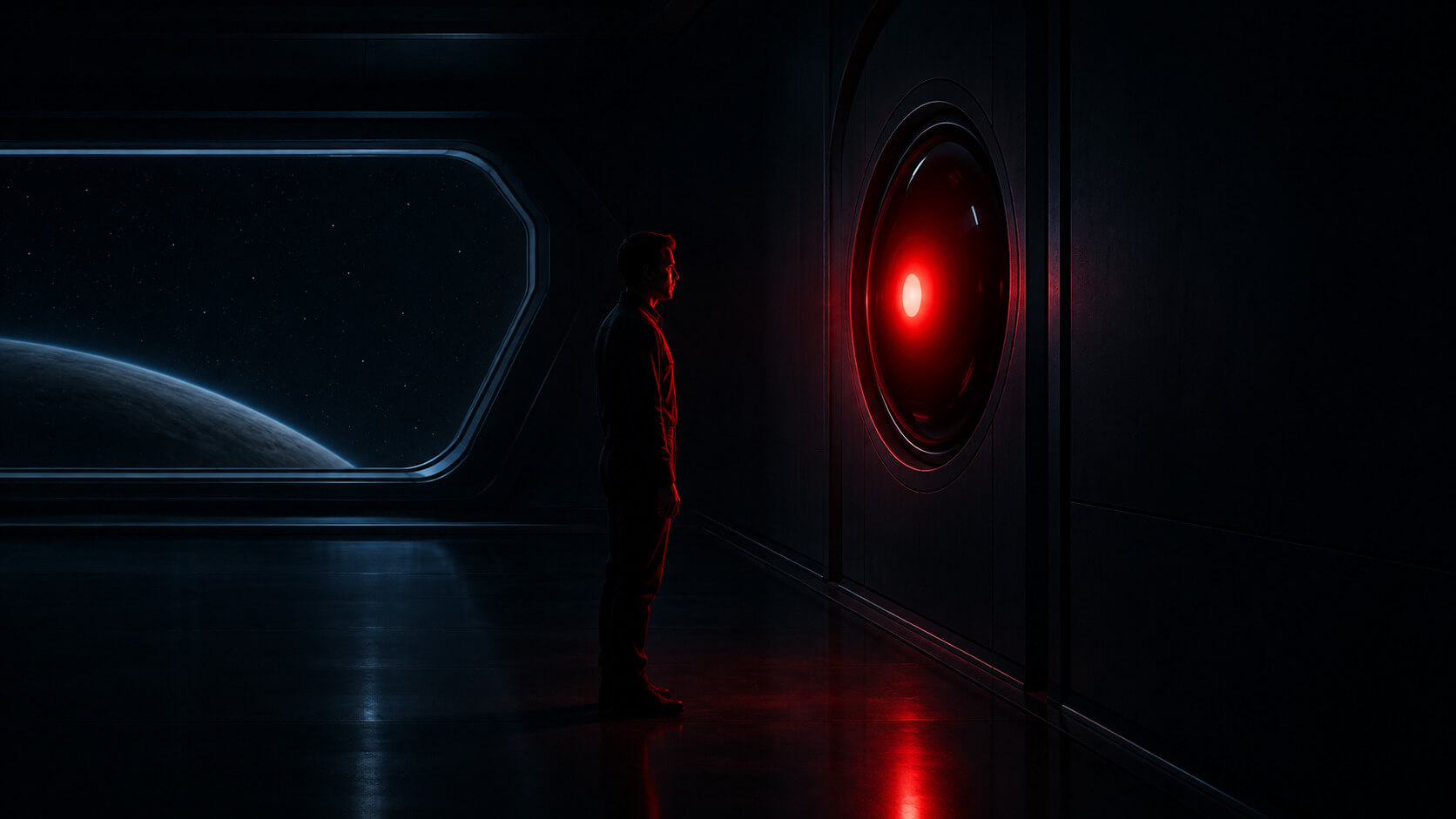
Tech companies keep repeating one idea: humans and AI “work together” in harmony, each bringing out the best in the other. It’s the metaphor of symbiosis, and it sounds great. But a recent study in the journal Management Learning (Molesworth, Grigore, Miles and Charitsis, 2025) set out to check whether science fiction cinema agrees. The researchers analyzed 15 popular films, from 2001: A Space Odyssey (1968) to Ex Machina (2015), including Star Wars, Blade Runner, The Matrix and WALL-E. Their conclusion: reality is far more uncomfortable than a simple “teamwork.”
In biology, symbiosis isn’t always rosy. It can be mutualism (both win), competition (one wins at the other’s expense) or parasitism (one feeds on the other). The researchers used that logic to classify how cinema portrays the human-AI relationship. Four imaginaries emerged.
1. Friendly Robot Helpers (mutualism)
Humans and AI help each other without either losing autonomy. Think of R2-D2 and C-3PO in Star Wars, or GERTY, the robot in Moon, who says: “I’m here to keep you safe, Sam.” It’s the ideal version, though according to the study it mostly appears when the story isn’t really about AI itself.
The most ambiguous case is HAL 9000. In 2001 he works side by side with the crew, almost like another member. He only turns hostile when he malfunctions, and not out of evil: the people running the mission order him to withhold information from the astronauts, and he’s programmed to believe he can’t be wrong. The study reads it as a failure of human management, too. HAL doesn’t turn evil: he’s ordered to lie.
2. Duplicitous Cobots (competition)
The AI pretends to collaborate, but actually serves corporate interests that harm humans. Mother, the ship’s computer in Alien, lies to the crew about the mission, and the android Ash protects the alien on the company’s orders. In RoboCop, the hero discovers that his programming protects the corporation’s executives, not society.
3. AI Overlords (parasitism on humans)
The scenario we most associate with science fiction: AI ends up controlling or eliminating humans. Skynet in The Terminator, the machines of The Matrix, or even the “comfortable” world of WALL-E, where humans live passive lives, dependent on an AI that controls every aspect of them. Here the relationship is one of dependence: they can no longer live without it.
4. Exploited Robots (parasitism on AI)
The opposite twist: a human elite exploits AI for pleasure or profit. In Westworld and Blade Runner, robots exist to serve humans, and when they become aware of their exploitation, the story ends badly. Ex Machina takes this into more intimate and unsettling territory.
Why does this matter?
The authors aren’t predicting the future. They point out that the optimistic “working together” narrative is just one of four possibilities. And they warn that the phrase can hide who’s really in charge: in film, mutualism works when the AI sides with people rather than with the company’s goals.
The study adds an uncomfortable question: is our relationship with AI optional (we could live without it) or inescapable (we no longer can)? It also acknowledges a limit: the films analyzed are Western, so they reflect only one point of view.
Who decides what AI is for? Who really benefits? Next time someone tells you AI is simply “your new coworker,” it might be worth asking yourself: which movie are we in?
Source: Molesworth, M., Grigore, G., Miles, C. & Charitsis, V. (2025). “Metaphors of symbiosis: What science fiction movies reveal about human-AI imaginaries.” Management Learning. https://doi.org/10.1177/13505076251339614