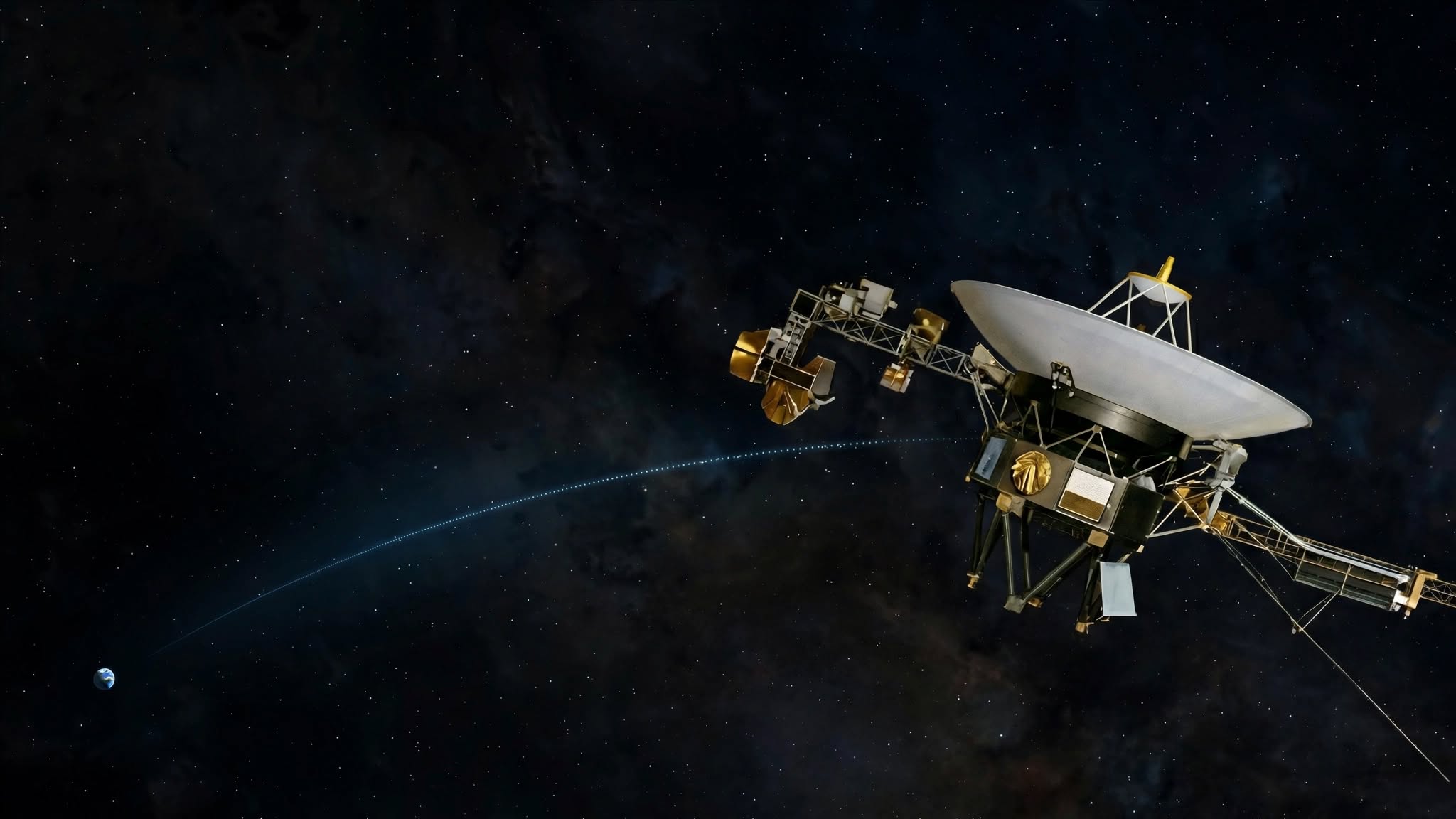
On November 18, a spacecraft launched in 1977 will reach a distance where even a simple “hello” takes two days to get an answer. How it copes with that silence is a lesson for every machine we plan to send, or build, to act on its own.
The 48 hours when nobody answered
On October 18 and 19, 2026, NASA’s Deep Space Network tried to hear from Voyager 1 and got nothing: two scheduled contacts, two blanks. On October 20 the signal came back. Engineers then found that one set of the probe’s thrusters had stopped working, and that the spacecraft had switched to its backup thrusters on its own, through its onboard fault-protection system. When JPL reported the episode, NASA had not determined why the silence happened in the first place.
Nobody ordered that switch. Nobody could have: at that distance, a command needs about a full day just to arrive.
A number that changes what “contact” means
On November 18, Voyager 1 will be one light-day from Earth, roughly 25.9 billion kilometers (16.1 billion miles). Light takes 24 hours to cover that distance one way. A question sent today gets its answer, if all goes well, in 48 hours. And for every one of those hours, the spacecraft is a machine that cannot ask anyone for help.
That is the problem space engineers call communication delay. It sounds like a technicality. It is actually a design philosophy.
Autonomy’s oldest job: knowing when to stop
A 2020 white paper led by NASA’s Jet Propulsion Laboratory (Amini et al., 2020) makes the logic explicit. Autonomy, the authors explain, is not a luxury that arrives when machines get clever. It becomes necessary when the time a command loop takes (analysis on the ground, uplink, execution, downlink) is longer than the time in which things happen. When the communication timescale exceeds the dynamical timescale, planning everything in advance from Earth can no longer guarantee safe control.
That is why the first autonomous functions on spacecraft were the unglamorous ones: guidance, control and fault protection, the jobs with the shortest clocks. The paper’s example is Galileo. Radiation at Jupiter kept knocking it into safe mode, but a “smart safing” routine kept it in a thermally safe attitude to protect its instruments even after operators lost control in an instant.
A second paper, which we will meet in a moment, describes the traditional design philosophy in one sentence worth remembering: build into the flight software only what is needed for safety, and when anything goes wrong, the spacecraft puts itself in a safe state and waits for help from the ground (Muscettola et al., 1998).
Now look back at October. A thruster fails. The probe switches to a backup and waits. That is the traditional philosophy in miniature: the machine’s one big decision is a conservative one.
From “open valve 17 at 20:34” to “be there within 24 hours”
In 1998, a team at NASA Ames and JPL published a paper whose title borrows the most famous mission statement in science fiction: Remote Agent: To Boldly Go Where No AI System Has Gone Before (Muscettola et al., 1998). It opens with a joke about HAL 9000. HAL’s fictional birthday, January 12, 1997, had just come and gone, and there was no HAL, no moon base, nothing.
The authors then pivot to what they saw as the real future of space: robotic explorers with a form of onboard intelligence.
Their starting point is how spacecraft were commanded. Traditionally, a spacecraft receives a time-stamped list of extremely low-level instructions, the kind that say to open a particular valve at an exact minute. That rigidity leaves it with little room to maneuver when something fails. And the cost shows up on the ground: a mission like Cassini needed a ground crew of 100 to 300 people at different stages, mostly to respond to extraordinary situations, not to run the nominal mission.
Remote Agent changes the contract. Instead of a script, it receives goals, for example performing an engine calibration within a 24-hour window, and works out how. It has three parts: a planner that builds the schedule, an executive that carries it out and adapts, and a diagnostic module that works out what has broken and finds the cheapest way to restore function.
The authors explain the design with Apollo 13. When that crisis hit, humans on the ground had to diagnose multiple simultaneous failures, improvise a new hardware configuration, write a new mission sequence under severe power limits, and assemble the procedures to execute it. Remote Agent’s job was to do a simpler version of those same four things, on board, when nobody can be reached.
Two details keep it honest. Even this thinking machine keeps a floor: if it cannot repair its plan, it aborts, enters a stable standby state and asks for a new plan, the same stop-and-wait move Voyager made in October. And thinking is slow. With the onboard processors of the time, the planner could take up to eight hours to produce a plan for one week of operation, about six percent of mission time, while the spacecraft kept executing.
Why isn’t every spacecraft a Remote Agent?
The 2020 white paper is blunt about it. Autonomy keeps proving itself, yet it rarely becomes standard practice. On Curiosity, an autonomous targeting system pointed an instrument at preferred outcrop terrain over 93% of the time, against 24% for blind targeting. On the 2004 Deep Impact mission, onboard navigation was unavoidable to hit a 7-kilometer comet at 10 kilometers per second, and its decisions could be modeled and supervised well enough to be trusted. Technology demonstrations like Remote Agent on Deep Space 1, however, did not transition to routine science missions.
The authors’ diagnosis is mostly cultural. Autonomy is a system-level technology, not a part you swap in, and institutions fear its risk more than they count its benefits. They revive a 1980 report to NASA, the Sagan Report, which already called the agency’s use of machine intelligence “conservative and unimaginative.”
The 1998 paper names the other half of the problem. When engineers meet autonomous software, the question they ask most insistently is how anyone can be sure it will work as advertised and avoid unintended behavior. The authors’ answer is to build systems whose knowledge is written in declarative models that humans can inspect, instead of burying it in code only experts can read.
The real question isn’t “can it decide?”
Here is the part that makes this more than a space story. The Remote Agent authors insist that extreme autonomy is needed for certain mission phases, but that support for human interaction is just as essential whenever such interaction is possible. In their design, ground operators can update the mission profile asynchronously and feed the agent new knowledge without interrupting it. The 2020 paper pushes in the same direction, recommending a shift from time-based sequencing to goal-based commanding.
Humans set the goals and the limits. The machine covers the gap.
Voyager 1 at one light-day is the limiting case of that arrangement: a stretch of 24 hours in which there is nobody to ask. What it carries across that gap was written by people decades ago: rules, priorities, a preference for stopping safely over improvising. One of the 1998 authors’ colleagues put the bargain in a single line: we will send our spacecraft beyond the horizon, accepting that we cannot directly control them, and “relying on them to tell the tale.”
The distance that raises this question is no longer only measured in kilometers. We are building machines that act on our behalf in places we cannot watch, and the hard part was never whether they can decide. It is who writes the rules they carry when we are out of reach.
Sources
- Amini, R., et al. (2020). Advancing the Scientific Frontier with Increasingly Autonomous Systems. White paper, Jet Propulsion Laboratory, California Institute of Technology, and collaborators. https://arxiv.org/abs/2009.07363
- Muscettola, N., Nayak, P. P., Pell, B., & Williams, B. C. (1998). Remote Agent: To boldly go where no AI system has gone before. Artificial Intelligence, 103, 5–47. https://doi.org/10.1016/S0004-3702(98)00068-X
- NASA/JPL, news release on Voyager 1’s one-light-day milestone, via ScienceDaily (November 3, 2026). https://www.sciencedaily.com/releases/2026/11/261103003152.htm