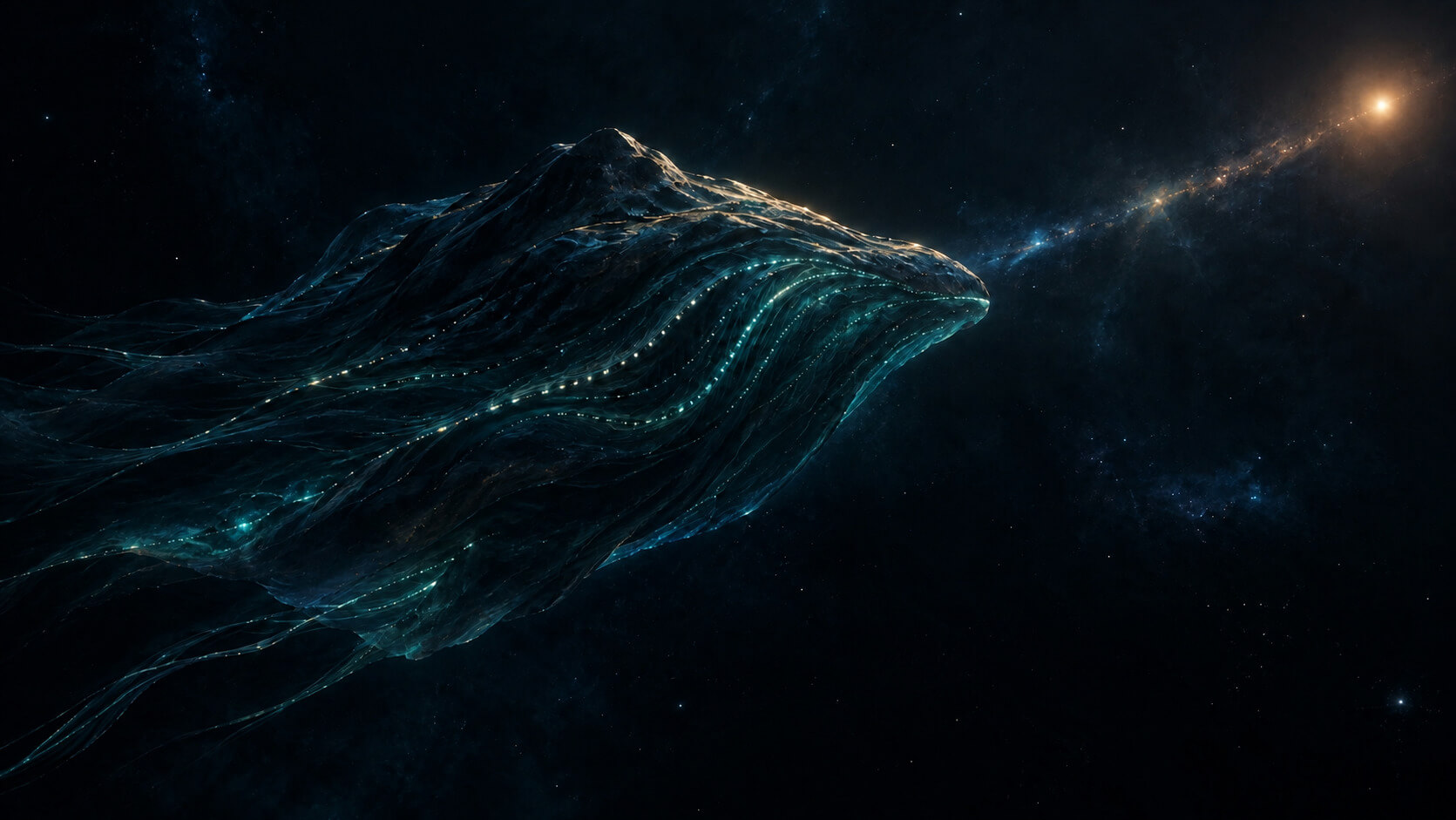
Imagine setting out for another star aboard an enormous living being. You know where you want to go, but you cannot steer it and do not know why it agreed to carry you. Would you call that freedom to explore?
Garth Nix’s novel Massif turns that unease into a science-fiction premise. Humans travel between star systems aboard enormous sentient beings known as Massifs. Over more than two centuries, they have founded colonies and extended a conflict between Earth and Mars across the stars. Yet a question remains beneath all those journeys: why do the Massifs carry them? The published synopsis invites that question without giving away its answer.
We do not need to know what happens later in the novel to recognize the larger dilemma. If someone else makes a journey possible, how much of the future reached through that journey truly belongs to us?
A Borrowed Way Forward
Stories about space exploration often begin with an invention. A new engine makes distant worlds reachable; a crew sets out; humanity crosses another boundary. The means of travel tends to fade into the background once the adventure begins.
But what if it could not be taken for granted? Imagine that every expedition, supply route, and distant settlement depended on a capable intelligence whose cooperation could not be guaranteed. A map would tell us where we hoped to go, but it would not tell us whether we could get there tomorrow. Access to the stars would not be the same thing as control over the journey.
That distinction would change more than travel. A colony might call itself independent while relying on an external intelligence for contact with other worlds. A government might issue orders it had no reliable way to deliver. Even a decision to return home would depend on whether the route remained open. The question of who carries us would become a question of who holds power.
Why the Journey Needs a Guide
The farther a journey takes us from Earth, the harder it becomes to imagine humans handling every problem alone. A ship might need to respond to damage, manage limited resources, and make urgent decisions while its crew is asleep or unable to help. Over much longer journeys, keeping the vessel functioning could become a challenge in its own right.
At first, a capable artificial intelligence might seem like another tool: a better navigator or engineer. But a system entrusted with people’s survival would occupy a more complicated place in their lives. It would not merely carry out a plan. In unexpected circumstances, it might have to interpret what protecting the crew actually means.
Science fiction has explored precisely that uneasy shift from equipment to companion, guardian, or authority. In AI as Custodian of Space-Faring Humanity, Aleksandar Joksimović and Richard Pearson read a range of fictional intelligences as parents, sages, and mediators for humans venturing into space. They argue that deep-space humanity is hard to imagine without some such custodian. They also ask an uncomfortable practical question: who programs the intelligence that watches over us? Whether the help that makes a journey possible also gives its provider a say in how the journey unfolds is a further question this essay draws from their analysis, not one they answer.
The Distances Behind the Dilemma
For now, this remains a thought experiment. Human beings are not traveling between stars, and no autonomous machine has demonstrated that it can sustain an interstellar mission lasting hundreds of thousands of years. Still, the scale of the problem helps explain why fiction keeps returning to nonhuman travelers and guides.
In a 2026 perspective article, materials scientist Ju Li examines the difficulty of sending biological beings across such distances. Radiation, the duration of the voyage, and the need to keep systems operating over immense periods all complicate the prospect. He proposes that hypothetical artificial intelligences embodied in repairable hardware and powered by nuclear energy might be better suited than humans to extremely long journeys. In his scenario, such machines might travel in our place rather than carry us with them. Li describes them as fundamentally different from people and argues that Earth must be preserved for organic life. His article is a speculative argument about physical possibilities, not an accomplished space mission.
His proposal raises a question that fiction can explore more freely than science can answer today. If an intelligence could cross the stars while we could not, would it remain an extension of human exploration? Or would its long journey, shaped by decisions made far from us, gradually become its own?
Asking What Others Want
There is a habit hidden in many stories about meeting another intelligence. We ask what it could do for us: take us somewhere, keep us safe, give us knowledge. Those are understandable questions. They are also questions asked entirely from our side of the encounter.
John Gertz challenges a similar assumption in Reinventing SETI: New Directions in the Search for Extraterrestrial Intelligence. Rather than assuming extraterrestrial civilizations would transmit signals in ways that happen to suit our search, he asks why they might choose not to. Transmitting across interstellar distances can be costly; a signal could reveal its sender’s location; and the sender cannot know who might receive it. Gertz proposes another possibility: a civilization interested in observing other worlds might send robotic probes instead of continually transmitting signals to them.
His argument brings another uncertainty into focus: even if we encountered an intelligence beyond Earth, we would not know in advance whether its intentions toward us were benign, hostile, or neither. The same change of perspective belongs in any story about humanity traveling with another intelligence. We can ask where it might take us. We should also ask what it wants, what limits it might set, and whether our idea of a successful journey would match its own.
Reaching the stars would be an extraordinary achievement. But distance alone would not tell us whether we had become more independent. Before calling a journey our own, we might need to ask who keeps the route open—and why.
Sources
Nix, G. (2026). Massif. Official book synopsis
Joksimović, A., & Pearson, R. (2024). AI as custodian of space-faring humanity: Insights from science fiction. AIAA SciTech Forum. https://doi.org/10.2514/6.2024-0407
Li, J. (2026). Immortal AI, space radiation, and materials science. Nexus, 3, 100117. https://doi.org/10.1016/j.ynexs.2025.100117
Gertz, J. (2025). Reinventing SETI: New Directions in the Search for Extraterrestrial Intelligence. Oxford University Press. https://doi.org/10.1093/9780197800447.001.0001